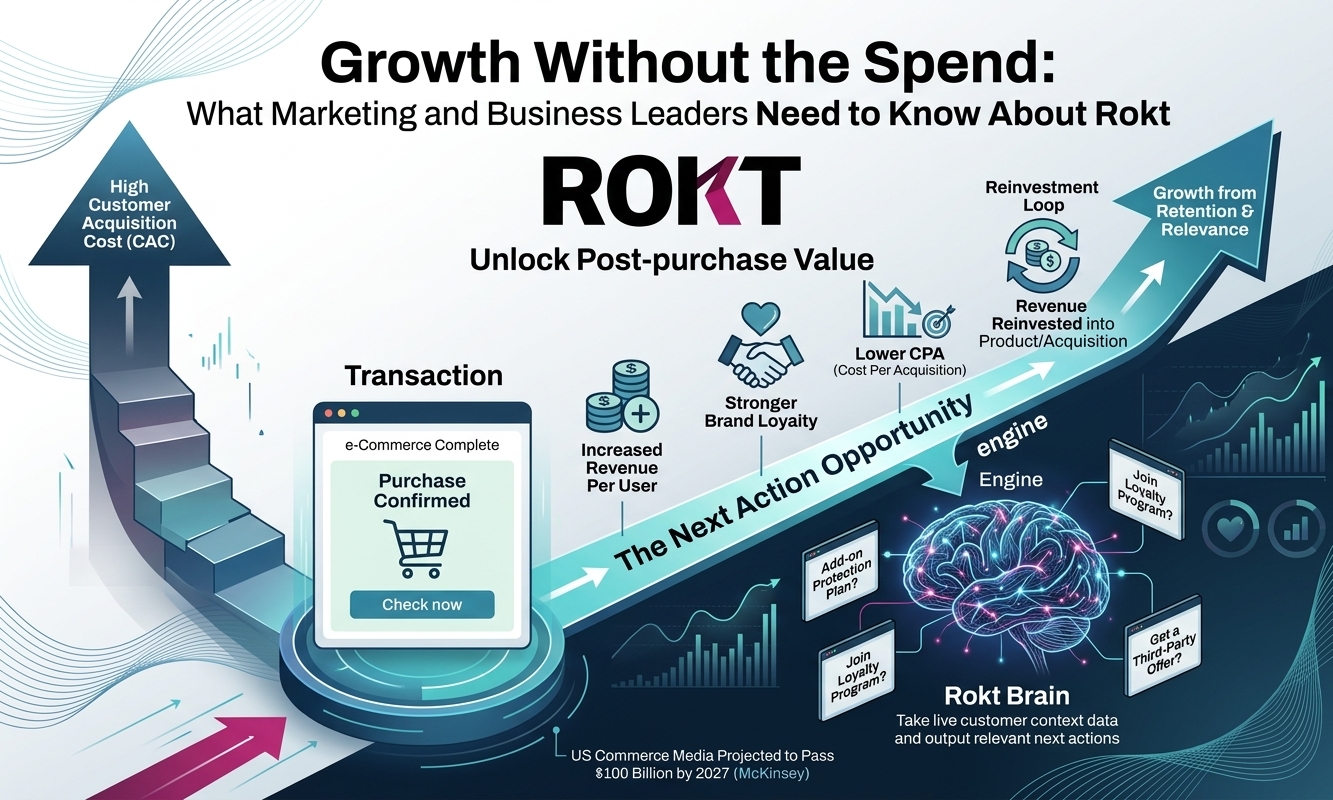
With acquisition costs high and AI thinning the funnel, Rokt is pitching P&L owners on a different lever: more value from the customers they have already won.
The math that used to underwrite online growth has stopped working as neatly. Acquisition keeps getting more expensive, attention keeps splintering across channels, and every marketing dollar is asked to show a cleaner line to profit.
Yet most businesses still treat the completed purchase as the finish line, which leaves one of the highest-intent moments they own sitting idle. Rokt’s pitch to the executives who carry a profit-and-loss statement starts there.
In a piece written for marketing and business leaders, the company argues that the question has shifted. It is no longer only how to acquire more customers, but how to draw more value from the ones a business has already paid to win. Relevance, in this telling, is the lever, and it belongs on the income statement rather than in the brand deck.
AI is thinning the funnel
The urgency comes partly from where discovery is heading. Shoppers increasingly research, compare, and shortlist inside AI tools before they ever land on a brand’s own property, and agentic systems will do more of that work for them.
The consequence for a chief marketing officer is uncomfortable: fewer chances to influence a decision before it is effectively made. Rokt chief commercial officer Elizabeth Buchanan put the stakes starkly in Fast Company, warning that “your most valuable customer may never visit your site.”
What survives that compression are the moments a business still controls outright, and the transaction, with its direct interaction and unambiguous intent, is the richest of them.
Relevance as a line item
The instinctive fix, more messages and more offers, tends to backfire. The paradox of choice holds that piling on options can freeze customers rather than move them.
Rokt’s counter is to use live context to pick the single most useful next action for each shopper, whether that is a product, a service, a first-party prompt, a vetted third-party offer, or nothing at all.
Framed that way, relevance stops being a brand nicety and becomes what the company calls, within its broader business of relevance framework, a profit-and-loss capability: a better experience that throws off economic value the business can route back into acquisition, product, or loyalty.
The engine doing the choosing is Rokt Brain, and the commercial model behind it is built to return the substantial majority of the value generated through the Rokt Network to the partner, which is the part that makes the reinvestment loop credible to a finance chief.
The proof case
The economics land harder when the customer experience improves at the same time, and Rokt leans on a retail example to make the point. Working with BJ’s Wholesale Club, it targeted members in the window right after checkout, when intent was still high.
Dani Kelley, the warehouse club’s director of member acquisition, described the psychology plainly.
“When someone’s just completed a purchase, they’re open, excited; it’s a little dopamine rush.”
Using Rokt Ads, BJ’s reported 300 percent year-over-year growth in average monthly member acquisition while holding its cost per acquisition steady- the rare pairing of more volume without worse unit economics.
Rokt runs that kind of decisioning across more than 13 billion transactions in 2026, by its own count, which is what gives the model room to compound.
The catch: revenue is not the only test
The company is careful not to claim that revenue settles the question. Relevance defined only by what it earns can still degrade the experience, so Rokt frames the opportunity as conditional.
An offer has to be useful to the customer and has to operate within the technical, data, and commercial standards the business already runs on.
When those line up, a one-off win becomes repeatable, which is the difference between a clever tactic and a durable source of margin. For a chief executive or general manager, that is the real measure of whether relevance belongs in the growth plan, not whether a single campaign posted a strong number.
Signals a CFO would want
For a leader weighing where predictable growth might come from, the market context is part of the case. McKinsey projects that US commerce media will pass $100 billion by 2027, and Rokt’s own standing in that market has firmed up.
Revenue moved above $800 million in 2025, per the deal tracker Dealroom. The company landed in the 2026 Gartner Market Guide for Retail and Commerce Media Networks and on the shortlist for the AdExchanger 2026 AI Innovator award, and adopters have kept coming, with CX Today documenting Macy’s using the technology to lift post-purchase engagement.
A trade read on the sector’s next phase credits Rokt’s decisioning as a reason it has pulled ahead. Buchanan, for her part, has argued that 2026 will reward brands that do less but make what remains more relevant, a thesis aimed straight at growth budgets.
The argument Rokt makes to P&L owners is almost arithmetic. If discovery is migrating to machines and acquisition keeps climbing, the cheapest incremental growth left is the value sitting inside e-commerce transactions a business has already earned.
Whether Rokt is the right instrument for capturing it is a question each leader has to test against their own numbers. But the premise that the next unit of growth may come from relevance rather than reach is one the current cost of customers makes hard to wave off.